
Best Branching Dialogue Game Maker for Creators
Find the right branching dialogue game maker for visual novels and choice-based games with zero-code tools, logic depth, and faster production.
·7 min read
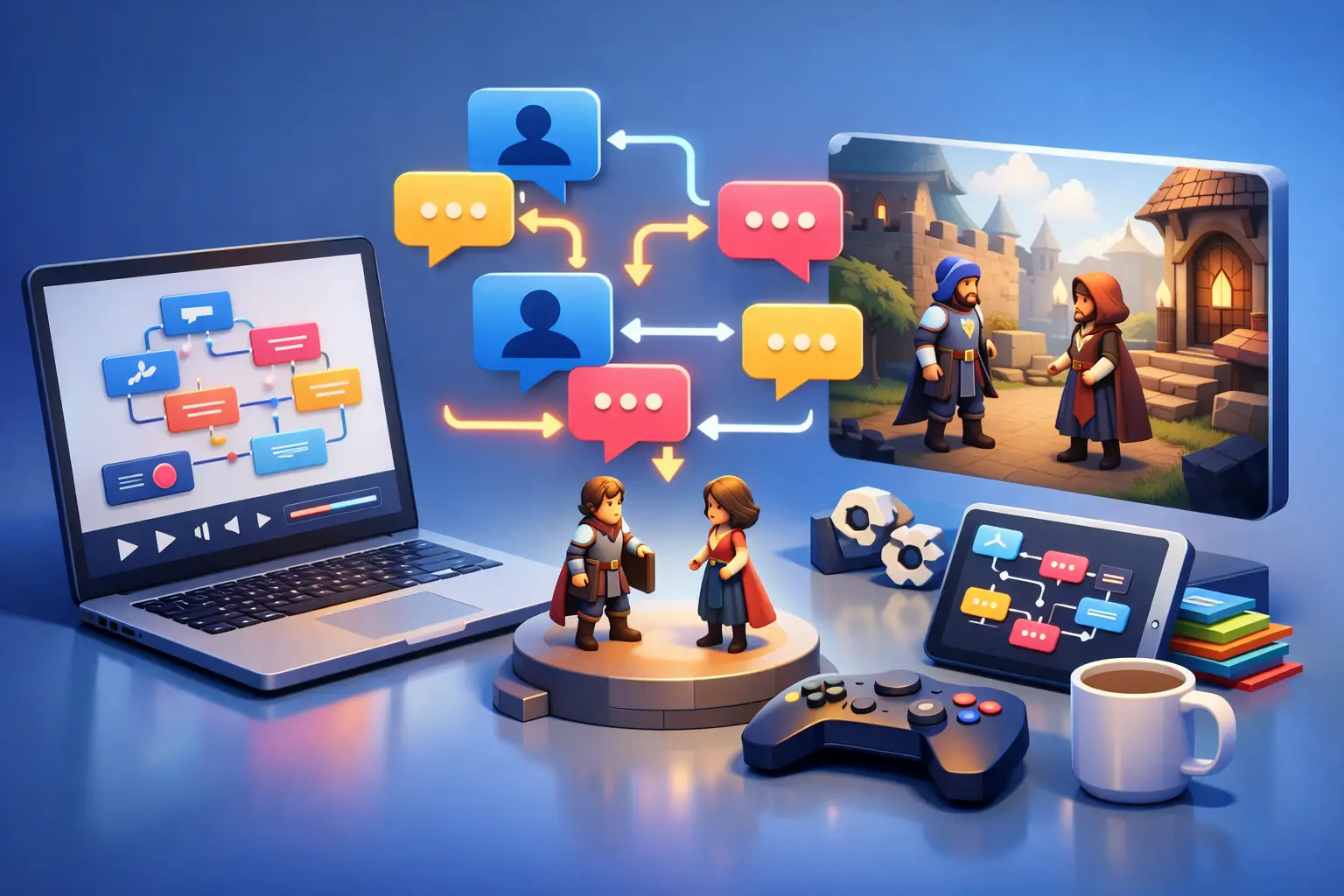
The moment your story needs a choice that actually changes something, most game tools start showing their limits. A basic dialogue editor can handle a few lines and a yes-or-no branch, but a real branching dialogue game maker needs to manage consequence, pacing, character state, and production speed without turning your project into a logic mess.
That distinction matters more than most creators expect. If you are building a visual novel, an interactive romance, a mystery with route splits, or an episodic story game, dialogue is not just text on screen. It is your progression system, your character design tool, and often your entire gameplay loop. The software you choose has to support that reality from day one.
What a branching dialogue game maker actually needs to do
A branching dialogue game maker should do more than display conversations and jump between scenes. At minimum, it needs to support choice-based flow, variables, conditions, route tracking, and reusable story logic. Without those systems, every new branch adds production friction and makes revision harder.
The biggest issue is scale. A short prototype can survive on manual links between scenes. A full game cannot. Once you introduce relationship values, hidden flags, inventory checks, alternate endings, locked scenes, and character-specific responses, you need a structured way to organize logic visually and test it quickly.
That is why dedicated narrative tools tend to outperform generic no-code builders for this kind of work. General platforms can be flexible, but they often make story development feel like system assembly. A purpose-built narrative editor starts from the assumption that creators need to write, branch, preview, and revise continuously.
Why generic tools break down on dialogue-heavy games
Plenty of creators begin with software that was not designed for dialogue-first games. It makes sense at first. A general game builder may promise drag-and-drop workflows and broad feature support. The catch is that broad support is not the same as efficient support.
When narrative becomes the core of the game, a generic setup often creates unnecessary overhead. You may need separate tools for writing, flowcharting, sprite organization, translation, state logic, and export. The project works, but every update travels through too many layers.
That fragmentation costs time in three places. First, story changes become technical changes. Second, testing branches becomes slower because context is spread across multiple systems. Third, polishing the final experience takes longer because presentation features were added as afterthoughts rather than designed around narrative delivery.
For solo creators and small teams, that trade-off is expensive. The real bottleneck is usually not imagination. It is production drag.
The right workflow for a branching dialogue game maker
The best workflow keeps writing, logic, assets, and preview close together. When those parts live in one place, you can move from concept to playable scene with less friction and fewer handoffs.
A strong branching dialogue game maker should let you map scenes visually, connect decisions clearly, and apply conditional logic without writing code. That does not mean reducing complexity. It means handling complexity in a way that remains readable as your game grows.
This is where visual editing matters. If a creator can see the structure of routes, identify dead ends, trace variable-based outcomes, and adjust pacing without digging through scripts, iteration gets faster. You spend more time shaping player experience and less time debugging the architecture of your story.
Real-time preview also becomes a serious advantage, not just a convenience. Branching narrative design depends on constant testing. You need to know whether a choice feels meaningful, whether a route triggers correctly, and whether emotional beats still land after revisions. A slow test cycle weakens both writing and production.
Features that separate a serious narrative tool from a simple dialogue editor
A lot of software can claim dialogue support. Fewer tools can carry a full commercial narrative project. The difference usually comes down to system depth.
Variables and conditional branching are the baseline. You also need support for scene transitions, save systems, galleries, inventory mechanics, route memory, and event triggers. For many projects, multilingual support is not optional either. If localization is part of your plan, the tool should make translation practical from the beginning rather than forcing a retrofit later.
Asset management matters just as much. Dialogue-heavy games still depend on sprites, backgrounds, CGs, sound, UI styling, and timing. If your editor cannot organize those cleanly, production slows down as content volume increases.
Then there is export quality. A game maker may feel easy during development but become limiting at release if export options are weak or distribution workflows are unclear. Creators need confidence that the work they build can be packaged, played, and shared without compromising structure or presentation.
Zero-code does not mean low ceiling
There is still a lingering assumption that zero-code tools are only for beginners. That view misses the point. The real value of zero-code is not simplicity for its own sake. It is speed, clarity, and accessibility without sacrificing production depth.
For dialogue-driven games, zero-code design can be especially powerful because it removes the gap between writing intent and system implementation. Writers can directly build the route logic they imagine. Artists can understand scene flow without needing engineering support. Small teams can keep momentum because fewer tasks get blocked behind technical specialization.
Of course, zero-code is not automatically better in every scenario. If a team needs highly custom systems far outside narrative gameplay, a more code-centric workflow may make sense. But for visual novels and choice-driven experiences, the strongest zero-code platforms are often the ones that feel most aligned with the actual work creators do every day.
Where AI helps in branching dialogue development
AI is useful in narrative production, but only when it supports the creator instead of replacing judgment. In a branching dialogue game maker, the best use cases are acceleration tasks: generating draft dialogue, translating text, analyzing assets, or helping structure repetitive production work.
That matters because branching games multiply content fast. One scene can become five versions of itself depending on player state, route conditions, or language support. AI can reduce the time spent on first-pass generation and localization, especially for indie teams with limited bandwidth.
Still, this is an area where trade-offs matter. Fast generation is not the same as strong writing. Character voice, pacing, subtext, and emotional continuity still require human control. The right platform treats AI as a production tool inside a serious editor, not as a substitute for authorship.
Why a specialized platform changes the outcome
A dedicated narrative platform gives creators a more direct path from idea to release. Instead of stitching together a writing app, a flowchart tool, a logic layer, an asset folder system, and a packaging workflow, you work inside an environment built for interactive storytelling from the start.
That is the practical difference behind tools like Mimmo Engine. Rather than acting as a generic no-code builder with narrative features added on later, it is structured around professional visual novel production: drag-and-drop editing, story mapping, branching logic, asset management, real-time preview, multilingual export, and integrated AI support inside a single workflow.
For creators, that means less setup and more forward motion. You can build route logic, manage character presentation, test scenes, and prepare a distributable narrative product without leaving the editor every few minutes. That kind of continuity is not just convenient. It directly affects how fast you can finish.
Choosing the best branching dialogue game maker for your project
The best choice depends on the shape of the game you want to build. If your project is mostly linear with light choices, a simpler editor may be enough. If your game depends on route complexity, state tracking, replay value, or episodic expansion, you will benefit from a platform with stronger narrative infrastructure.
Look closely at how the tool handles branching at scale. Can you visualize story paths clearly? Can you manage variables without friction? Can you preview outcomes quickly? Can your team organize assets and localization in the same production space? Can you export something that feels release-ready?
Those questions matter more than broad feature lists. A branching dialogue game maker should not just help you start. It should help you finish with quality intact.
The strongest tools are the ones that let your story become more ambitious without making development more fragile. If your game lives or dies on choices, character routes, and replayable outcomes, choose software that treats narrative structure as the foundation, not a side feature. That decision will shape not only how you build, but whether you keep building when the project gets real.
Keep reading
- How to Write Branching Dialogue That WorksLearn how to write branching dialogue for visual novels and choice-driven games with clear structure, stronger choices, and less rewrites.
- Best Episodic Story Game Software for CreatorsFind the best episodic story game software for visual novels and branching games, with the tools, workflow, and export features creators need.
- Game Dialogue Translation Tool for VN TeamsA game dialogue translation tool can speed up visual novel localization, preserve branching logic, and reduce manual errors for indie teams.