
Sprite Management for Visual Novels That Scales
Sprite management for visual novels affects speed, consistency, and polish. Build a cleaner workflow for expressions, poses, layers, and scenes.
·7 min read
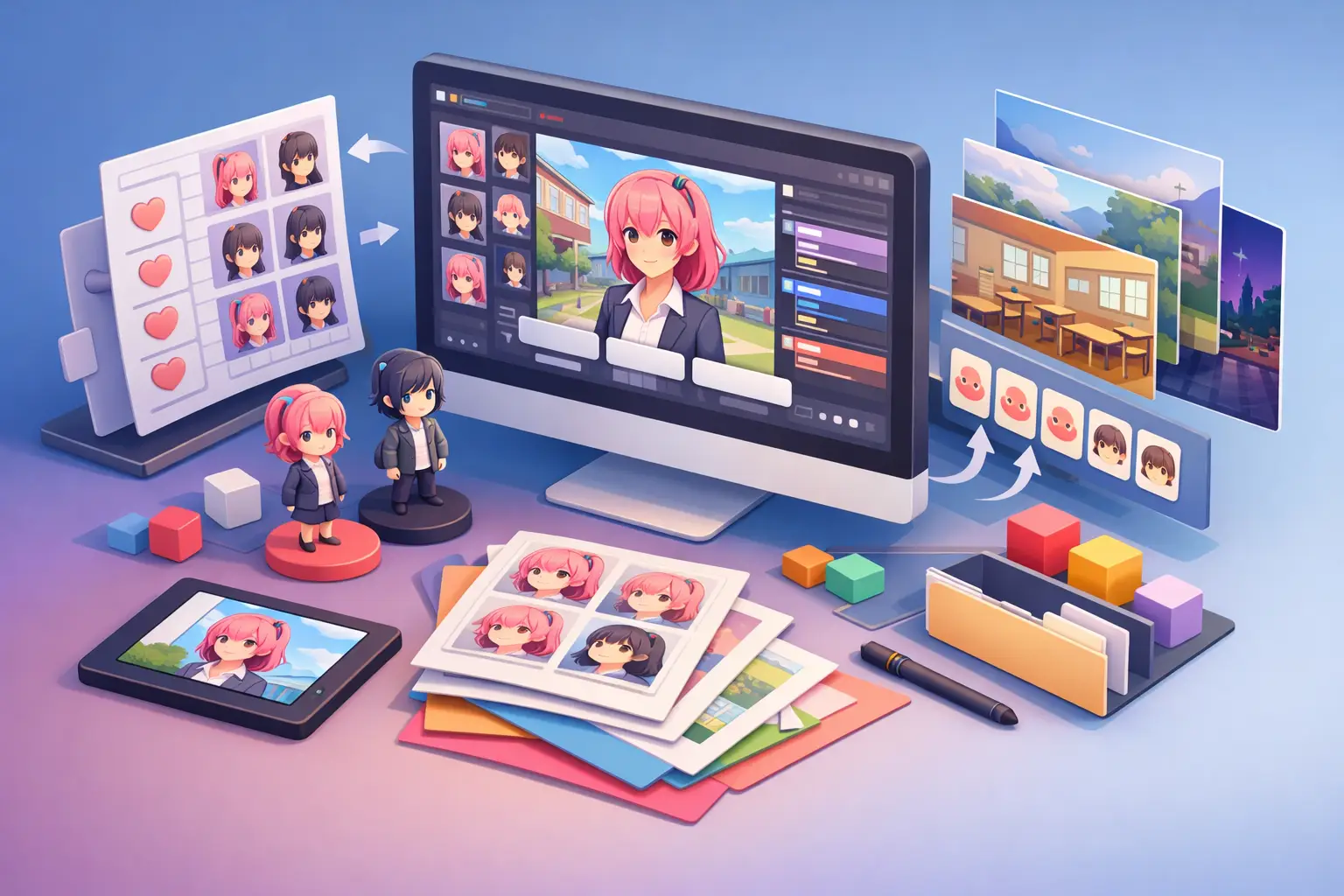
The moment a cast grows past two characters, sprite management for visual novels stops being a small art task and turns into a production system. What looked simple at prototype stage - import a pose, swap an expression, place a character on screen - can become a mess fast when every scene needs emotional variation, outfit changes, layered parts, and continuity across routes.
That pressure shows up in ways creators feel immediately. Dialogue pacing slows down because scenes take too long to assemble. Naming gets inconsistent. Revisions become risky because changing one sprite may break ten moments elsewhere. And when your project is episodic or multilingual, asset confusion compounds instead of staying contained.
Good sprite management is not about being obsessive. It is about protecting momentum. If your visual novel pipeline can handle character art cleanly, every other part of production gets easier - writing, staging, QA, editing, and final export.
What sprite management for visual novels really includes
Most creators think of sprite management as file storage. That is only part of it. In practice, it covers how character visuals are structured, named, previewed, reused, and updated throughout development.
A workable system needs to answer a few production questions. Can you find the right expression in seconds? Can you tell which version is approved? Can the same base character support multiple outfits without duplicate files everywhere? Can you update an asset once and trust that your scenes stay consistent?
For visual novels, this matters more than in many other game genres because sprites are not occasional decoration. They carry emotion, rhythm, and scene clarity. A slight eyebrow change or body angle can alter how a line reads. That means your art library is tightly connected to narrative design, not just presentation.
Why messy sprite libraries hurt more than you expect
The obvious cost is time. If a creator spends thirty seconds hunting for the correct sprite every few dialogue beats, scene construction becomes tedious. Over a full project, that is not a small inconvenience. It is lost production capacity.
The less obvious cost is decision fatigue. When files are disorganized, creators start second-guessing everything. Is this the latest version? Did we already make a sad-but-composed expression? Is this outfit supposed to appear before chapter three? That uncertainty slows teams down and makes solo creators feel like they are constantly rebuilding context.
There is also a quality issue. Inconsistent sprite usage creates tonal drift. A serious confrontation can lose impact if a neutral expression slips in by mistake. A continuity error can make a branching route feel careless even if the writing is strong. Players may not always identify the source of the problem, but they notice when staging feels off.
Build sprites around combinations, not single files
One of the biggest decisions in sprite management for visual novels is whether to treat each character state as a fully exported image or as a combination of reusable parts. The right answer depends on your art style and production goals.
If your game uses a smaller cast, limited pose variation, and painterly full-body sprites, flattened files may be faster. They are easy to preview and generally easier for beginners to manage. The trade-off is scale. Once you add many expressions, costume changes, or partial animation, duplication grows quickly.
Layered sprite systems take more planning up front but usually pay off on larger projects. A base body, face set, eyes, mouth, outfit, and accessory layers can support many combinations without forcing artists to redraw or export every state as a unique file. This also makes revisions more efficient. If a jacket color changes or a face line needs cleanup, you can update a layer instead of replacing dozens of finals.
It depends on your project scope. For a one-hour jam game, fully exported sprites may be perfectly practical. For an episodic release with recurring cast members, a modular structure is often the safer long-term choice.
Naming conventions are not boring - they are infrastructure
A strong naming system saves more time than most creators expect. Without one, search breaks down, duplicates appear, and scene assembly becomes guesswork.
The key is to name assets by production logic, not personal habit. Character name should come first, followed by pose, expression, outfit, and version. That structure makes sorting useful and keeps related files together. Short, predictable labels work better than clever ones. “mia_pose01_happy_school_v2” is more helpful than “mia_new_final_revised.”
Version control matters too. “Final” is not a version. It is a future problem. If an asset changes, label it clearly and archive old states with discipline. That matters even more when multiple collaborators touch art, writing, and scene setup at different times.
Folder structure should mirror how your team actually works. Some teams organize by character first. Others split by chapter because scene-based production is their main bottleneck. Neither is universally correct. The best structure is the one that reduces ambiguity in your actual workflow.
Keep staging tied to narrative intent
Sprite systems are often discussed as technical organization, but staging should lead the structure. A visual novel does not need infinite expressions. It needs the right emotional vocabulary for the story.
That means every character should have a deliberate sprite matrix. What does this person look like when guarded, amused, threatened, affectionate, or lying? Which pose is their default in casual scenes, and which one signals stress or authority? When sprite planning starts from narrative function, asset creation becomes leaner and more coherent.
This also helps avoid overproduction. Many creators spend weeks generating tiny variations they barely use. Meanwhile, they are missing one crucial pose needed for a recurring dramatic beat. Quantity alone does not improve scene direction. Coverage does.
A focused library also makes writing stronger because the available visual states support consistent characterization. When your tools reflect how the cast behaves, scene building gets faster and more expressive at the same time.
Preview speed changes everything
A sprite library is only useful if creators can work with it at scene speed. That is where dedicated visual novel tooling has a real advantage over generic builders and patchwork workflows.
If you can drag sprites into scenes, test expressions in context, and preview dialogue flow without bouncing between separate apps, you make better creative decisions faster. You are not just organizing files. You are shortening the distance between idea and result.
This is especially valuable for solo developers and small teams who do not have a technical pipeline engineer handling asset logic in the background. A specialized editor should reduce the friction of swapping poses, layering visuals, and checking transitions in real time. That is part of what makes production feel manageable instead of fragile.
Mimmo Engine fits this workflow well because it combines sprite and asset management with scene building, branching logic, and live preview inside one zero-code environment. For visual novel creators, that kind of integrated pipeline is not a convenience feature. It is a serious production advantage.
Plan for change, because your sprites will change
No visual novel keeps the same asset plan from start to finish. Characters evolve. Scripts expand. Artists improve. Routes reveal edge cases you did not anticipate early on.
That is why flexible sprite management beats perfectly neat but rigid systems. Your setup should allow new expressions, alternate costumes, holiday variants, censored or regional art adjustments, and revised proportions without forcing a total rebuild.
Localization can also affect sprite usage more than expected. A scene may need different line timing, UI spacing, or emotional emphasis depending on language. If your staging is hard-coded around awkward asset handling, multilingual production gets harder. If your sprites are well organized and easy to remap, expansion is much more practical.
This is another area where creators should think beyond the first release. If your game succeeds, you may need updates, platform-specific builds, bonus content, or sequels reusing the same cast. Clean sprite management turns existing art into a reusable production asset instead of a pile of old files.
The real goal is creative throughput
The best sprite workflow is not the most complex one. It is the one that lets you move from writing to staging to polish without losing control. That usually means consistent naming, a structure built around character combinations, and a toolset that keeps asset handling close to the story editor.
There is no single perfect standard for every project. A short romance prototype and a long branching mystery need different levels of asset depth. But both benefit from the same principle: treat sprites like part of your narrative system, not an art folder you clean up later.
When your character assets are organized for speed and revision, you stop fighting the production process and start shaping scenes with intent. That is when visual novel creation feels less like file management and more like directing.
Keep reading
- How to Make Visual Novels That Feel PlayableLearn how to make visual novels with zero-code workflows, branching logic, asset planning, and polished exports for real release.
- Do Visual Novels Need Programming?Do visual novels need programming? Learn when code helps, when it doesn't, and how zero-code tools can still ship polished narrative games.
- Best Ren'Py Alternative for Visual NovelsLooking for a renpy alternative for visual novels? Compare coding, workflow, exports, and no-code tools to choose the right engine faster.