
Can Writers Make Games Without Coding?
Can writers make games without coding? Yes - with the right zero-code tools, writers can build polished visual novels and interactive stories fast.
·8 min read
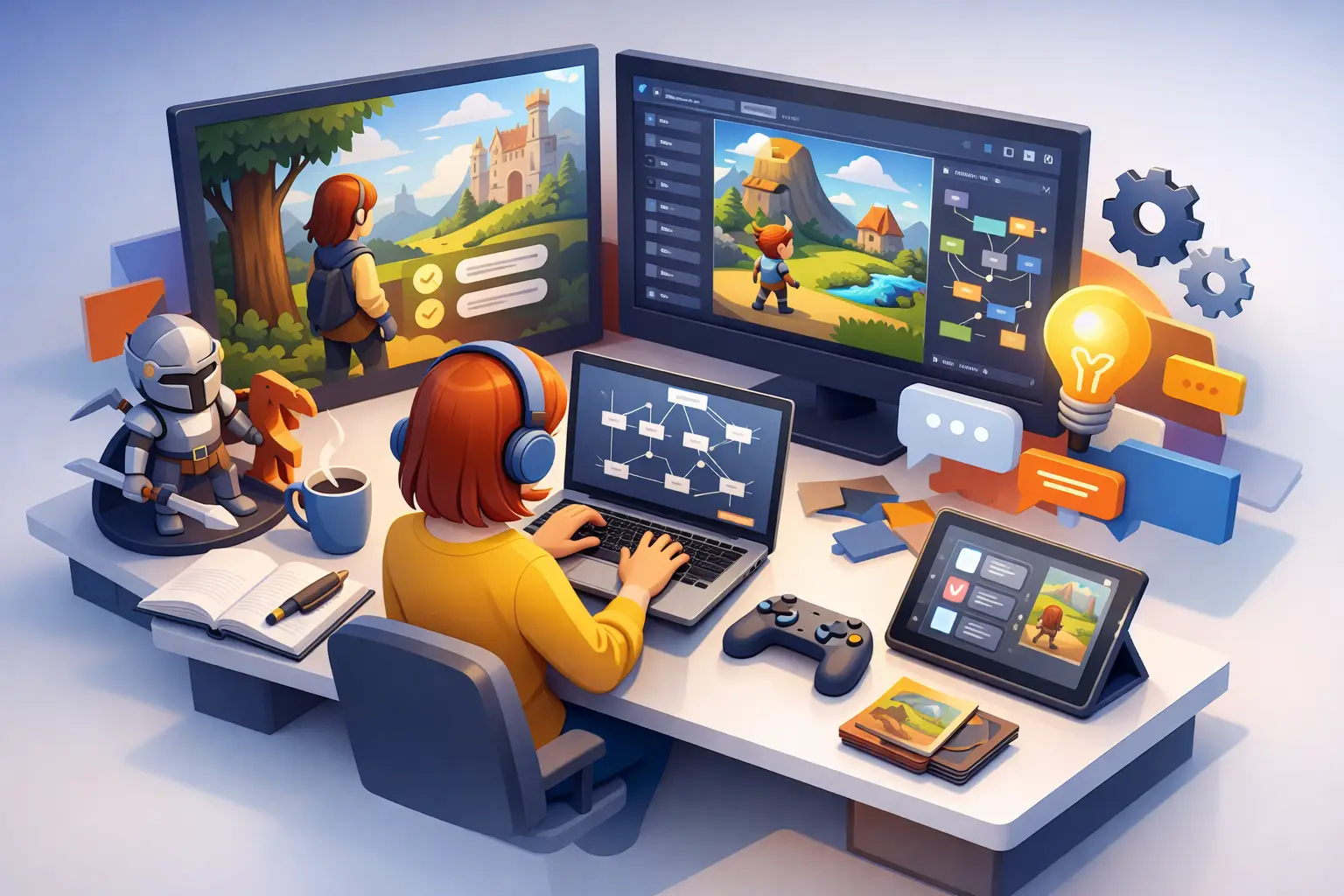
A lot of writers hit the same wall at the same moment. The story works, the characters have chemistry, the branching choices are mapped out on paper, and then reality shows up with variables, state tracking, UI logic, save systems, and export settings. That is usually when the question gets real: can writers make games without coding? The short answer is yes, but only if they use tools built for narrative production rather than trying to force a writing workflow into a general-purpose game engine.
That distinction matters more than most people think. A writer does not need to become a programmer to make an interactive story. But a writer does need a development environment that turns story structure into game logic without requiring manual scripting at every step. When the tool is designed around scenes, choices, assets, and branching conditions, the technical barrier drops fast. When it is not, the writer ends up spending more time learning systems than writing scenes.
Can writers make games without coding in real production?
Yes, and not just as a prototype.
Writers can build publishable games without coding when the game format matches the tool. Visual novels, choice-driven stories, dating sims, episodic interactive fiction, and dialogue-heavy narrative games are especially well suited to zero-code workflows. These formats depend less on custom physics or real-time combat and more on scene flow, character states, branching logic, inventory rules, galleries, transitions, and presentation.
That is where specialized zero-code platforms become credible production tools rather than beginner shortcuts. A serious narrative editor should let you control branching paths, variables, unlock conditions, multilingual content, asset pipelines, and preview behavior from one place. If those systems are fragmented across five tools, the "no coding" promise quickly turns into hidden technical labor.
This is why many writers struggle with broad game engines. Those engines are powerful, but power is not the same as fit. If your core work is writing scenes, organizing routes, managing dialogue, and shipping a polished narrative experience, then a dedicated visual novel workflow is usually faster, easier to learn, and more reliable.
What writers actually need to make a game
Writers rarely need "coding" in the abstract. What they need is control.
A game based on narrative still has systems. Choices must lead somewhere. Relationship points need to update. A locked scene may need three prior events to be completed. A gallery may unlock when a route ends. A save system has to preserve state. Text needs to sync with character art, backgrounds, sound, and transitions. None of that requires hand-written code if the editor exposes those systems clearly.
The real requirement is logic design, not software engineering. That is good news for writers because logic design is already close to story design. Writers think in cause and effect. If the player chooses this, a character reacts that way. If trust is high, a later confession scene appears. If the player found an item earlier, the confrontation changes. That is game logic, and many writers are already doing it before they ever touch a development tool.
The difference is that a strong zero-code platform gives that logic a visual structure. You are no longer writing syntax. You are connecting scenes, setting conditions, assigning variables, and previewing outcomes in an editor that speaks the language of narrative production.
Where zero-code works best and where it does not
The most honest answer to can writers make games without coding is yes, with scope awareness.
If you want to create a professional visual novel with branching dialogue, route management, sprite changes, cinematic transitions, save slots, galleries, inventories, and multiple endings, zero-code tools can absolutely handle that. In many cases, they are the better option because they remove unnecessary setup and keep the entire project inside a workflow built for story-first development.
If you want to build a 3D action RPG with custom combat systems, procedural environments, and networked multiplayer, that is a different conversation. At that point, code or a highly technical team usually becomes necessary.
This is not a weakness of no-code creation. It is just production reality. The more your game depends on custom mechanics outside narrative interaction, the more likely you are to hit the edges of any visual editor. For writers, though, that edge is often much farther away than expected. A polished narrative game can include far more system depth than people assume, especially when the platform supports variables, branching logic, asset management, multilingual export, and interactive UI elements from the start.
Why writers often do better with specialized tools
The biggest productivity gain does not come from removing code alone. It comes from removing workflow friction.
Writers lose momentum when story mapping lives in one app, art references in another, dialogue in documents, variables in spreadsheets, and testing in a separate build process. Every handoff slows iteration. Every tool switch increases the chance of broken logic or missing assets. A dedicated zero-code narrative platform compresses that pipeline so the writer can move from draft to playable scene without rebuilding the same information in multiple places.
That matters for solo creators and small teams because narrative projects grow fast. One chapter becomes five. A simple route split becomes ten state checks. Localizing text doubles content management. Suddenly the project needs more than a script editor. It needs production infrastructure.
This is where a platform like Mimmo Engine fits naturally. It is built specifically for professional visual novel creation, so the workflow centers on drag-and-drop scene construction, story mapping, sprite and asset management, branching logic, real-time preview, multilingual export, and AI-assisted production inside one editor. For a writer, that means less time fighting setup and more time shaping the player experience.
Can writers make games without coding and still look professional?
Absolutely, but polish comes from systems, not just writing quality.
A professional narrative game needs consistent pacing, clear UI behavior, stable progression logic, visual cohesion, and dependable exports. Players notice when choices feel fake, when route locks are confusing, or when presentation breaks immersion. Zero-code tools can support professional output, but only if they provide enough depth to manage those details deliberately.
That includes features many writers do not think about at first: save systems, galleries, inventory interactions, variable-based scene gating, transition control, text presentation, and testing tools. These are not extra features tacked on at the end. They are part of how the game feels complete.
The good news is that writers tend to have an advantage here. They already care about pacing, emotional payoff, continuity, and structure. Once the editor makes production systems accessible, those instincts translate well into game design. A writer who can manage narrative architecture can often build a stronger interactive experience than a technically skilled developer with weak scene writing.
The trade-off: no coding does not mean no learning
There is one misconception worth dropping early. Zero-code does not mean zero craft.
Writers still need to learn branching design, player feedback, route clarity, scene hierarchy, and scope control. They need to think about how choices affect later content and how to keep complexity from spiraling. They also need to understand the production side well enough to organize assets, test routes, and maintain consistency across chapters.
The difference is that they are learning game creation at the design level, not at the syntax level. That is a much better trade for most narrative creators. Instead of spending weeks debugging scripts, they spend that time improving character arcs, tuning choice consequences, and refining scene flow.
For many projects, that shift is what turns a stalled idea into a finished game.
What to look for in a zero-code tool as a writer
If your goal is to ship, not just experiment, choose a platform that treats narrative production as a full pipeline.
You want visual story mapping so route complexity stays readable. You want variable logic that does not require custom scripting. You want asset management built into the editor, not bolted on later. Real-time preview matters because interactive pacing is hard to judge from static text. Export options matter because finishing a game includes distribution, not just authoring. And if you plan to localize, episodically release, or iterate quickly, those capabilities should exist from day one.
AI features can also help, but only when they support the workflow instead of distracting from it. Dialogue generation, translation assistance, and image analysis are useful accelerators when they reduce production time without flattening your voice. For writers, the best AI is not there to replace authorship. It is there to remove repetitive friction.
So, can writers make games without coding? Yes - and in the right environment, they can make games that are polished, commercial-ready, and creatively ambitious. The real question is not whether writers are capable. It is whether their tools respect the way narrative games are actually built.
When the software is designed around story logic instead of programming syntax, writers stop being "non-technical" creators on the sidelines. They become what they already were at the start: game makers with a different production language.
Keep reading
- 10 Best Tools for Narrative GamesFind the best tools for narrative games, from writing and branching design to zero-code production, art pipelines, audio, testing, and export.
- How to Make Visual Novels That Feel PlayableLearn how to make visual novels with zero-code workflows, branching logic, asset planning, and polished exports for real release.
- AI Dialogue Generator for Games That ShipsSee how an ai dialogue generator for games speeds writing, supports branching scenes, and helps indie teams ship stronger narrative content.