
What a Choice Based Game Creator Should Do
A choice based game creator should do more than branch dialogue. Here’s what creators need for faster production and polished narrative games.
·7 min read
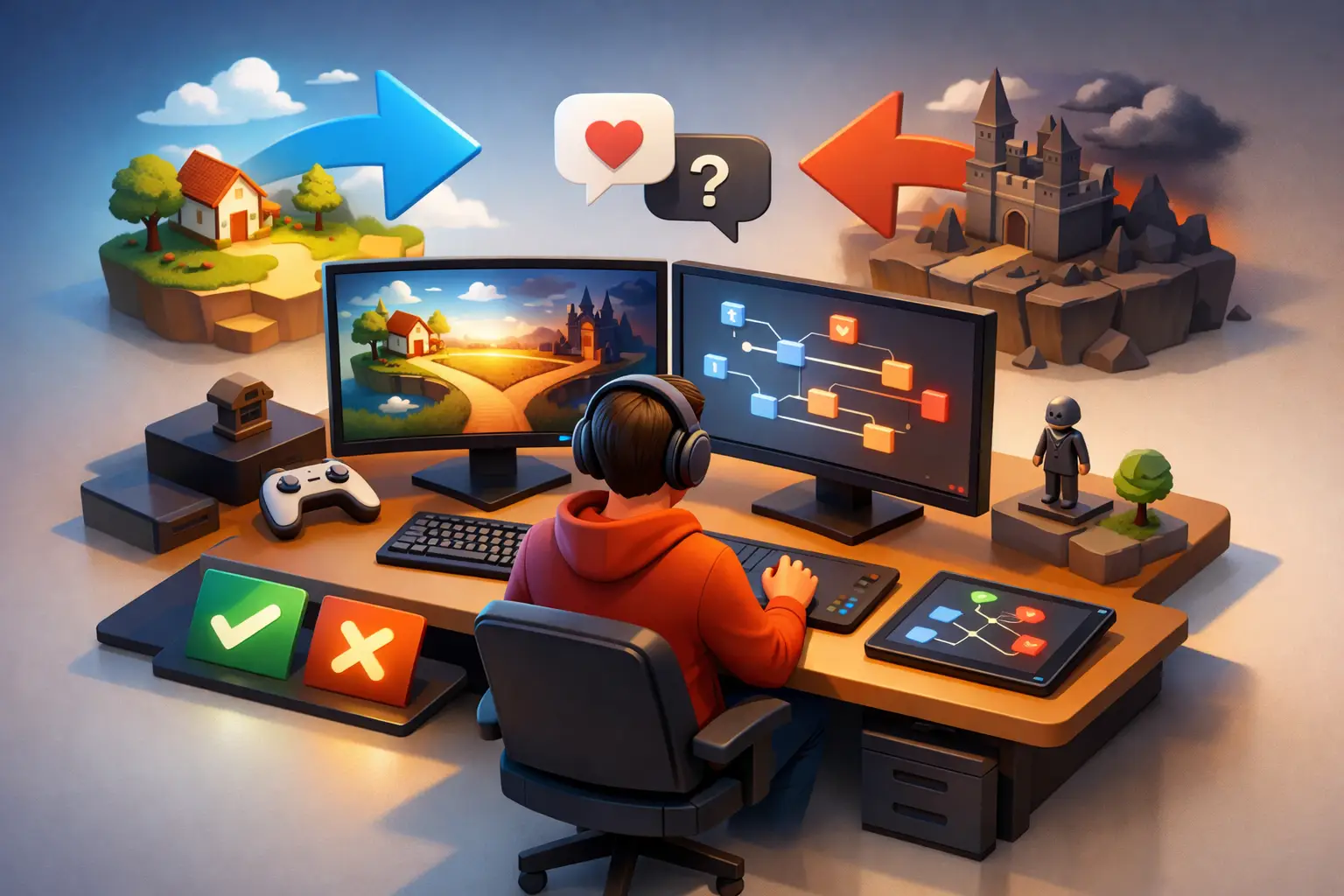
A good story can survive rough art for a while. It can even survive placeholder music. What usually breaks first is structure. The moment your branching narrative starts tracking flags, inventory items, alternate scenes, save states, and multiple endings, a weak choice based game creator turns into a bottleneck.
That is the real test. Not whether a tool can display dialogue choices, but whether it can support production once your game stops being a prototype and starts becoming a product.
What creators really need from a choice based game creator
Most people looking for a choice based game creator are not asking for a generic app builder with a dialogue box attached. They want a production environment built for narrative games. That means the writing flow, the logic system, the visual presentation, and the export process all need to work together.
This is where many tools split into two extremes. Some are easy to start with but collapse as soon as your project gets complex. Others are powerful but assume you are comfortable scripting everything yourself. If your goal is to build a visual novel, interactive romance, mystery, episodic drama, or character-driven branching story, that trade-off matters.
A serious narrative tool should remove programming friction without flattening your creative options. Zero-code should not mean low control. It should mean faster execution, clearer systems, and fewer technical dead ends.
The difference between branching dialogue and real game logic
A lot of platforms can present a choice and jump to another scene. That is the baseline, not the finish line.
Real narrative design usually needs variables, conditional paths, relationship tracking, hidden outcomes, scene gating, inventory checks, unlockable CGs, and replay support. Once you add those layers, your project stops being a simple flowchart. It becomes a system.
That is why the editor matters so much. If logic is buried in scattered menus or fragile script snippets, iteration gets slow. Writers lose confidence making changes. Small teams start spending more time testing structure than building story.
A stronger approach is visual logic that stays readable as the game grows. You should be able to map branches, manage states, and preview outcomes without constantly translating your creative decisions into code syntax. For creators who are building alone or with a small team, that speed is not a convenience. It is what makes the project finishable.
A choice based game creator should reduce workflow fragmentation
One of the biggest hidden costs in narrative game development is tool switching. Writing in one place, tracking branches in another, editing assets in folders, managing translations elsewhere, and testing inside a separate runtime creates friction every day.
That friction compounds. A character sprite gets renamed and breaks references. A branch update does not match the latest script draft. A translated line overflows the UI. The game technically works, but production becomes messy.
A dedicated choice based game creator should bring those systems into one editor. Story structure, scene building, asset organization, transitions, save behavior, variable logic, and preview should be part of the same workflow. When they are, iteration becomes much faster and quality control gets easier.
This is especially important for episodic projects and content-heavy visual novels. The more scenes you have, the more expensive fragmentation becomes.
Why visual novel creators need specialized features
If you are building narrative games, generic no-code tools often sound appealing at first. They promise flexibility, but flexibility is not the same as fit.
Visual novels and story-driven games have recurring production needs that deserve first-class support. Dialogue presentation is only one piece. You also need layered backgrounds and sprites, expression swaps, music and sound control, transitions, text pacing, choice UI, branching maps, galleries, save systems, and often multilingual output.
When those features are treated as add-ons, creators end up assembling basic genre conventions by hand. That burns time and increases the chance of mistakes. A specialized tool gives those systems structure from the beginning.
This is where a platform like Mimmo Engine fits naturally. It is designed around zero-code visual novel production rather than retrofitting narrative design into a general builder. That difference shows up in day-to-day work: drag-and-drop scene editing, built-in story mapping, asset handling, branching logic, multilingual support, real-time preview, and export workflows built for distributable narrative games.
AI can help, but it should not control the creative process
AI features are becoming common in creator tools, but their value depends on implementation. For narrative teams, AI is useful when it speeds up tedious work without turning the project into machine-generated filler.
The best use cases are practical. Dialogue generation can help break blank-page paralysis or create alternate phrasings. Translation support can accelerate localization prep. Image analysis can assist with asset tagging or content organization. These features save time when they are integrated into the editor and remain under creator control.
The wrong approach is treating AI as the product itself. Story games live or die on voice, pacing, and character intent. A good tool should accelerate output while preserving authorship. That balance matters more than flashy automation claims.
Export quality is where many tools reveal their limits
A project is not finished when the writing is done. It is finished when you can package, test, distribute, and trust what you built.
This is one reason many beginner-friendly tools disappoint advanced users later. They make creation look simple, but exporting a stable, polished game becomes restrictive. Performance issues appear. File handling gets awkward. Platform support is unclear. Versioning becomes messy.
A professional choice based game creator should treat export as a core feature, not an afterthought. Creators need confidence that their branching logic, media, saves, and structure will hold together outside the editor. That confidence becomes even more important if you plan to release episodes, distribute demos, or sell your project.
There is also a less obvious factor: integrity. Your exported project should preserve the game as designed, with dependable playback behavior and organized delivery. When a tool includes a dedicated playback environment and purpose-built export format, that can create a more controlled and reliable publishing pipeline than patching together generic outputs.
Ease of use should scale with ambition
There is a common misconception that beginner-friendly tools cannot support serious production. The truth is more specific. Poorly designed beginner tools struggle with complexity. Well-designed tools simply hide unnecessary friction.
That distinction matters for indie creators. Many projects start small and grow into something much bigger than expected. A weekend prototype becomes a ten-hour branching story. A solo experiment becomes a small studio release. If your editor cannot scale with that growth, you eventually have to rebuild or compromise.
The right platform should feel approachable on day one and still support advanced logic later. You should be able to create your first scene quickly, then expand into inventories, variables, galleries, custom styling, alternate routes, and language support without switching systems.
That kind of scalability is what turns a tool from a hobby experiment into production infrastructure.
How to evaluate a choice based game creator before you commit
The fastest way to judge a platform is not by counting features on a landing page. It is by asking what happens after chapter one.
Can you still read your branching logic after dozens of scenes? Can you manage assets without losing track of dependencies? Can you test changes quickly? Can you support multiple endings, hidden states, or item-based routes without writing custom code? Can you localize without rebuilding your UI? Can you export something that feels like a real game instead of a proof of concept?
Those questions separate a demo tool from a production tool.
It also helps to think about your role. If you are primarily a writer, you need a system that keeps logic understandable. If you are an artist, you need reliable sprite and scene management. If you are a small team, you need a shared workflow that reduces handoff problems. If you are planning commercial release, you need export confidence and professional presentation. The right answer depends on your project, but the pattern is consistent: specialized tools tend to outperform generic ones once the work gets serious.
A choice based game creator should not just help you start. It should keep pace with your story as it gets more ambitious, more layered, and more worth releasing. If the tool gives you speed without sacrificing control, you spend less time fighting systems and more time building scenes players actually remember.
Keep reading
- What a Drag and Drop Game Editor Should DoA drag and drop game editor should do more than place assets. See which features actually help creators build polished narrative games fast.
- Best Episodic Story Game Software for CreatorsFind the best episodic story game software for visual novels and branching games, with the tools, workflow, and export features creators need.
- How to Choose a Drag and Drop Game BuilderChoosing a drag and drop game builder? Learn what matters most for narrative games, exports, logic, assets, and long-term production speed.